
PCP remains detectable in your system for different durations depending on the test method: 1-4 days in blood, 7-14 days in urine (up to 30+ days for chronic users), 1-3 days in saliva, and up to 90 days in hair follicles. Detection windows vary based on your metabolism, body composition, usage patterns, and lifespan. Standard urine tests typically use a 25-50 ng/mL cutoff concentration. Multiple factors can greatly influence these timeframes beyond average estimates.
What Is PCP and How Does It Work in the Body
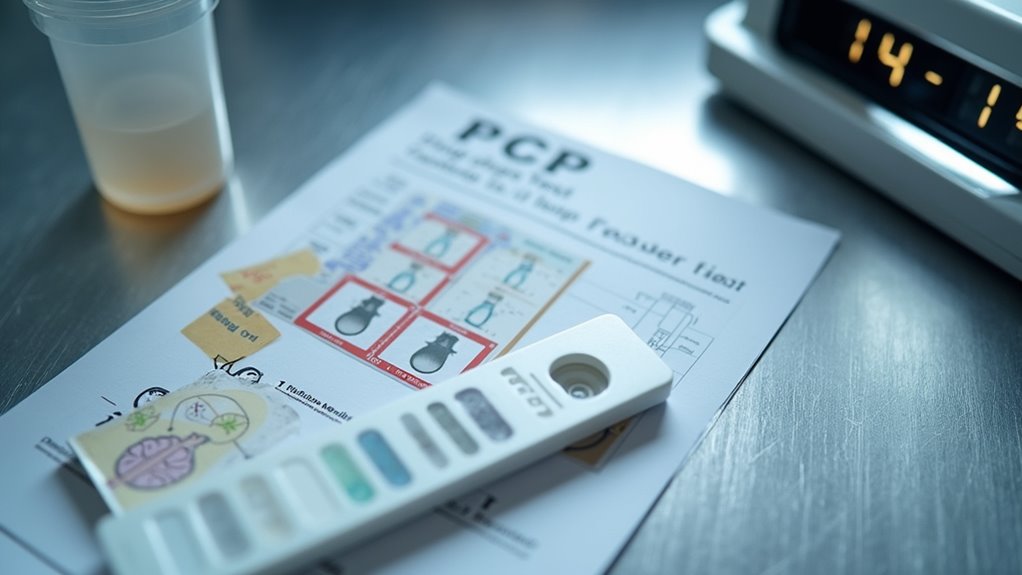
Phencyclidine (PCP), originally developed as a surgical anesthetic in the 1950s, functions as a dissociative drug that disrupts normal brain function by blocking the NMDA (N-methyl-D-aspartate) glutamate receptors. When you consume PCP, it rapidly enters your bloodstream and crosses the blood-brain barrier, producing its characteristic effects within 30-60 minutes. Its lipophilic properties allow it to be stored in fatty tissues, contributing to its extended detection window.
PCP’s history as a medical substance ended in 1965 when its severe side effects including hallucinations, delirium, and agitation proved too problematic for clinical use. The drug works by altering your perception of sight and sound while producing feelings of detachment from reality. PCP effects commonly include numbness, slurred speech, and in higher doses, dangerous symptoms like hypertension, hyperthermia, and potentially fatal respiratory depression.
Detection Windows for Different Testing Methods
Detection windows for PCP vary considerably across testing methodologies, with each method offering different sensitivity thresholds and timeframes. Blood and urine tests remain the most common screening approaches, with blood tests detecting PCP for 1-4 days and urine tests identifying metabolites for up to 7-14 days after use. Hair follicle analysis provides the longest detection window of up to 90 days, while saliva screening generally detects PCP use within a narrower 1-3 day timeframe.
Blood and Urine Tests
When analyzing how long PCP remains detectable in your system, blood and urine tests offer distinct detection windows. Blood analysis provides a shorter detection period, typically identifying PCP use for 1-3 days after consumption. Conversely, urine composition testing extends detectability to 7-14 days for casual users and potentially up to 30 days for chronic users due to PCP’s lipophilic properties.
- Blood tests demonstrate higher accuracy for recent use but require invasive collection procedures and show narrower detection windows
- Urine tests remain the most common screening method due to cost-effectiveness and non-invasive collection protocols
- Detection timelines vary greatly based on metabolic rate, dosage consumed, and frequency of use
These detection parameters prove critical for medical professionals conducting toxicology screenings and individuals undergoing mandatory testing protocols in employment or legal contexts.
Hair and Saliva Screening
Beyond blood and urine assessments, hair and saliva testing represent supplementary methodologies for PCP identification with markedly different detection timeframes.
In hair samples, PCP remains detectable for up to 90 days after use. This extended window occurs because the drug incorporates into your hair follicles during hair growth at approximately 0.5 inches per month. Testing typically uses the 1.5-inch segment closest to your scalp, representing your most recent 90-day exposure history.
Saliva screening offers a much briefer detection period, typically 1-3 days post-consumption. Variables affecting saliva composition including pH level, hydration status, and oral hygiene can influence detection sensitivity. While less invasive than blood testing, saliva screening provides a narrower surveillance window than urine analysis, making it primarily suitable for identifying recent PCP consumption rather than historical use.
Factors Affecting How Long PCP Remains in Your System

Several biological and behavioral variables influence the duration PCP remains detectable in your system. Your metabolic rate considerably impacts elimination speed, with higher rates typically clearing PCP faster. Individual physiological differences in liver enzyme function can alter processing efficiency by 20-40%.
- Body composition – Higher body fat percentages extend detection windows as PCP accumulates in adipose tissue
- Lifestyle choices – Hydration levels, exercise frequency, and dietary habits directly affect metabolic clearance rates
- Usage patterns – Frequency, dosage, and duration of PCP use create cumulative effects, with chronic users potentially testing positive for 30+ days
Age-related metabolic changes further complicate clearance timelines, with elimination typically slowing by approximately 5% per decade after reaching 40.
PCP Metabolism and Elimination Pathways
The body processes PCP (phencyclidine) through specific metabolic pathways that directly impact its detection timeline. When you ingest PCP, your liver metabolizes it through hydroxylation and oxidation, creating multiple metabolites that eventually exit through urine and feces.
| Metabolic Phase | Primary Process | Timeline |
|---|---|---|
| Initial Absorption | Bloodstream entry | 1-2 hours |
| Liver Processing | Hydroxylation | 4-8 hours |
| Secondary Metabolism | Oxidation | 8-24 hours |
| Storage | Fat tissue retention | Days to weeks |
| Elimination | Urinary/fecal excretion | Variable |
Your kidney function greatly affects PCP breakdown, with approximately 10% of the compound excreted unchanged. The remaining 90% undergoes complex metabolic pathways, creating at least five major metabolites. PCP’s lipophilic properties cause it to accumulate in fatty tissues, extending detection windows considerably.
Urine Testing: The Most Common Detection Method
Urinary analysis represents healthcare professionals‘ predominant method for detecting PCP presence, offering detection windows ranging from 3-7 days after single use to 30+ days following chronic exposure. When you provide a urine sample, immunoassay screening typically occurs initially, followed by confirmatory testing via gas chromatography-mass spectrometry (GC-MS) for improved testing accuracy.
- Standard cutoff concentrations for PCP detection in urine range from 25-50 ng/mL, with lower thresholds possible in specialized settings
- False positives can occur with dextromethorphan, ketamine, and certain antipsychotics that share structural similarities
- Hydration levels, urine pH, and metabolic rate considerably influence detection timeframes, with acidic urine potentially accelerating elimination
For maximum detection reliability, chain-of-custody protocols must be strictly followed during sample collection, transportation, and analysis to prevent contamination or tampering.
Blood and Saliva Tests for PCP Detection
Blood and saliva tests offer alternative detection methods for PCP, although they’re less commonly utilized than urinary analysis in most clinical settings. PCP typically remains detectable in blood for approximately 24-48 hours after use, providing a narrower detection window compared to urine testing.
Saliva accuracy has improved with newer testing technologies, allowing detection of PCP for up to 1-3 days following consumption. However, testing reliability can vary considerably based on collection technique, sample handling, and laboratory methodology. Factors affecting detection include metabolic rate, frequency of use, and dose consumed.
These testing modalities are primarily employed in emergency medicine when acute intoxication is suspected, or in forensic contexts where establishing recent use is critical. Their primary advantage lies in confirming active impairment rather than historical consumption.
Hair Follicle Testing and Long-Term Detection
Hair follicle tests can detect PCP use for up to 90 days after consumption, making them the longest-duration screening method available for this substance. Your hair grows approximately 0.5 inches per month, with PCP metabolites being deposited into the hair shaft through blood vessels connected to follicles as your hair grows. The test’s sensitivity varies based on your hair’s melanin content, with darker hair typically retaining higher concentrations of drug metabolites than lighter hair due to melanin’s binding properties with PCP molecules.
Detection Timeline Specifics
Unlike other testing methods, hair follicle analysis provides the most thorough detection window for PCP, capturing drug use patterns for up to 90 days after exposure. This extended timeline offers significant advantages for detailed monitoring programs that require historical detection capabilities.
Hair testing delivers superior testing accuracy compared to traditional detection methods, with sensitivity rates above 95% when performed in certified laboratories.
- Hair grows at approximately 1.3 cm per month, allowing technicians to establish a chronological map of PCP consumption
- Each 1.5-inch segment represents roughly 90 days of your drug use history
- Segmental analysis can distinguish between single use and chronic exposure patterns
You’ll find that environmental contamination rarely produces false positives, as testing protocols differentiate between external exposure and actual ingestion through metabolite identification.
Unique Hair Characteristics
While numerous biological specimens can be tested for PCP, your hair possesses distinctive characteristics that make it particularly valuable for long-term detection. Unlike urine or blood, hair follicles trap drug metabolites in their protein matrix as they grow, creating a chronological record of PCP use that can extend back 90 days or more.
Hair growth occurs at approximately 0.5 inches per month, allowing forensic analysts to segment samples and establish usage timelines with remarkable precision. Research shows that color variations in hair can affect detection sensitivity darker hair contains more melanin, which binds more readily with PCP metabolites, potentially leading to higher concentration readings. This melanin binding affinity means testing protocols must account for natural pigmentation differences to guarantee accurate interpretation of results.
First-Time vs. Chronic Use: Impact on Detection Periods
The frequency of PCP use greatly influences how long the drug remains detectable in your system. Initial users typically clear PCP more rapidly, with detection windows ranging from 1-7 days in urine. Chronic users experience greatly extended detection periods due to PCP’s lipophilic properties and its accumulation in fatty tissues.
- Initial users metabolize PCP within 1-7 days, with minimal tissue storage and faster elimination rates
- Chronic users may test positive for 2-4 weeks after last use due to drug accumulation in adipose tissue
- Heavy, long-term users can potentially test positive for up to 30+ days in urine tests and 90+ days in hair samples
The pharmacokinetic difference between user types stems from PCP’s 5.86 half-life, resulting in considerable bioaccumulation with repeated exposure, particularly in lipid-rich organs.
Medical Interventions That May Affect Detection Times
Multiple medical protocols can considerably alter PCP’s elimination kinetics in the body. Activated charcoal administration within 1-2 hours of ingestion can reduce absorption by 50-60%, shortening detection windows in subsequent testing. Urinary acidification (pH 5.5 or lower) accelerates PCP excretion rates by 2-4 times normal values, while alkalinization extends retention.
Your medical history considerably impacts intervention efficacy. Individuals with renal impairment experience prolonged detection periods regardless of intervention types. Hemodialysis shows limited effectiveness due to PCP’s high protein binding (65-72%) and lipophilicity. Naloxone administration doesn’t alter elimination rates but may mask detection in some immunoassays. Benzodiazepine therapy for symptom management doesn’t affect clearance mechanisms but remains essential in the clinical protocol. Phenytoin administration for seizure prophylaxis may create false positives in some screening methodologies.
Legal Considerations and Workplace Testing Policies
Federal regulations established under the Drug-Free Workplace Act of 1988 provide a thorough framework for PCP testing in employment contexts, specifying detection thresholds of 25 ng/mL for initial immunoassay screening and 25 ng/mL for confirmatory GC-MS testing. These workplace regulations vary by state and industry, with safety-sensitive positions facing stricter monitoring protocols.
Legal implications you should understand include:
- Refusal to test may result in termination in at-will employment states without violating federal labor laws
- Medical marijuana cards don’t typically exempt you from PCP testing requirements
- Positive PCP results may trigger mandatory reporting in regulated industries (healthcare, transportation)
You’ll find that pre-employment screenings commonly include PCP in standard 5-panel tests, while random testing protocols must adhere to company policies disclosed during your onboarding process.
Frequently Asked Questions
Can Second-Hand PCP Smoke Exposure Trigger a Positive Test?
Second-hand exposure to PCP smoke through passive inhalation could potentially trigger a positive test, though evidence is limited. You’re unlikely to test positive from brief, casual exposure in well-ventilated areas. However, concentrated exposure in enclosed spaces might result in detectable levels. The risk depends on proximity to the smoker, ventilation conditions, and test sensitivity. Unlike marijuana, where passive inhalation studies are more extensive, PCP-specific research on second-hand exposure thresholds for positive test results remains relatively scarce.
Does Drinking Water Help Clear PCP From Your System Faster?
While drinking water increases your hydration levels, there’s limited evidence that it greatly accelerates PCP elimination from your system. Increased water consumption may cause urine dilution, potentially reducing detectable PCP metabolite concentrations temporarily, but doesn’t fundamentally alter the drug’s elimination half-life. Your body metabolizes PCP primarily through liver processes that aren’t notably affected by hydration status. Laboratory technicians also screen for diluted samples, which might trigger further testing or be flagged as potentially manipulated.
Can You Detox From PCP Naturally Before a Drug Test?
Natural detox methods for PCP before a drug test have limited scientific support. Your body naturally eliminates PCP primarily through liver metabolism. While body cleansing through increased water intake, exercise, and adequate sleep may support your natural elimination processes, PCP’s fat-soluble properties and long half-life (21-24 hours) make rapid clearance difficult. Complete natural detoxification typically requires 1-4 weeks depending on usage patterns, metabolism, and kidney function timeframes that often exceed pre-test preparation periods.
Will Prescription Medications Cause False Positives for PCP?
Some prescription medications can trigger false positives for PCP during drug testing. Specifically, dextromethorphan (found in cough medicines), ketamine, tramadol, venlafaxine, and certain antipsychotics like thioridazine may cross-react with PCP immunoassays. If you’re taking prescribed medications, inform the testing facility before your screening. Laboratory confirmatory methods like GC-MS can differentiate between actual PCP consumption and false positives, ensuring accurate results. Always disclose your complete medication list to avoid misinterpretation of drug test results.
Can You Challenge a False Positive PCP Test Result?
Yes, you can challenge a false positive PCP test result. You have legal rights to request confirmation testing using more advanced methods like GC-MS (gas chromatography-mass spectrometry), which offers superior test accuracy. When contesting results, promptly document medications taken, request split sample testing, and consider consulting legal counsel. Many substances including dextromethorphan, ketamine, and certain antipsychotics can trigger false positives, which laboratories must acknowledge when evaluating contested results in employment or legal contexts.